
What should EAD case monitoring cost in 2026?
EAD case monitoring pricing matters when a pending I-765 affects your ability to plan work, onboarding, travel, or a renewal. The buying decision is usually simple: continue checking the USCIS website manually, choose a recurring subscription, or use a service with a single charge for monitoring through the case decision.
A useful comparison starts with the receipt number, not with the filing date alone. USCIS uses that number to identify the case, while the online case status page displays the latest publicly available status associated with it. You can review the official USCIS Case Status Online tool, but manual checking places the responsibility for remembering each check on you.
For an applicant who checks twice a day, even a modest routine can become dozens of visits each month. The financial cost may be zero, but the practical cost includes missed time, uncertainty, and the risk of noticing an important update later than intended.
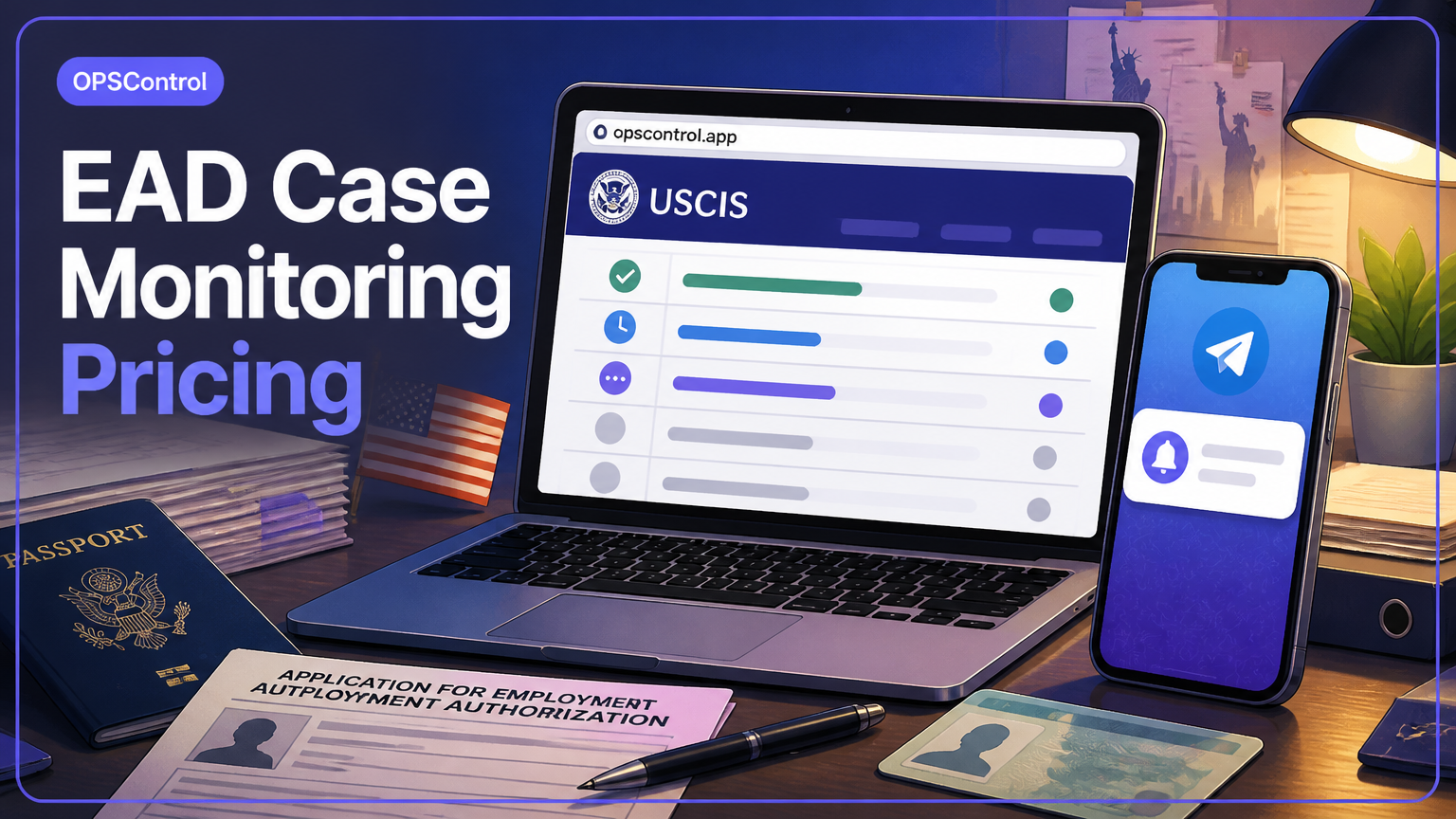
OPSControl is designed for this specific tradeoff. Its stated price is a one-time $1.99 charge per case, with monitoring continuing until the case reaches a decision and stopping automatically when the case is completed. This is a monitoring service, not legal advice, and a notification should always be read as a status change rather than proof of a favorable outcome.
One-time EAD monitoring pricing versus a monthly subscription
A one-time price is easier to evaluate when the service is tied to one USCIS case. You pay $1.99 once for an individual case instead of adding another recurring bill during an uncertain processing period. That distinction is especially relevant for I-765 applicants who do not know how long they will need to wait.
The value is not simply the number of alerts. It is the combination of continued monitoring, Telegram notifications when a detected status changes, silent update detection, and a historical timeline that lets you see what happened and when. A timeline can also give you a clearer record to organize before contacting USCIS or discussing the case with an immigration lawyer.
Families often need to track more than one receipt number. For cases, the listed price is $1.99 per case, which makes the model more predictable for households monitoring several I-765, I-485, I-130, I-751, or N-400 matters.
Before paying for any tracker, separate price from scope. Ask whether the service monitors one case or multiple cases, whether alerts continue after the first update, whether the history is preserved, and whether monitoring ends when the case is completed. Those details determine whether a low headline price actually fits your situation.
Why choose one-time EAD case monitoring?
No recurring subscription for the monitored case: the listed OPSControl price is $1.99 paid once, with monitoring intended to continue until the case decision.
Telegram alerts reduce the need to refresh the USCIS status page repeatedly. Delivery still depends on the underlying status source, detection, Telegram availability, and the contact details used during setup.
Silent update detection can help surface a change that may not be obvious during a casual manual check. It should be treated as an additional monitoring signal, not as a guarantee that every possible USCIS event will be identified.
A complete status history creates a practical timeline for your own records, conversations with an employer, or questions for an immigration lawyer.
The flat per-case price supports households managing several receipt numbers.
Support for common USCIS forms allows households to monitor related matters in one workflow instead of creating separate manual routines for every family member.
Automatic monitoring closure after case completion avoids paying for or maintaining an unnecessary tracking process after the case reaches its endpoint.
How to set up EAD monitoring without missing key details
Find the correct receipt number — Use the receipt notice for Form I-765 and copy the receipt number carefully. Do not confuse it with an A-Number, invoice number, online account number, or the receipt number for a different family member.
Confirm the form and applicant — Check that the case is an I-765 and that the applicant name or personal notes identify the right person. For families, label each case clearly so an alert is not assigned to the wrong household member.
Connect the notification channel — Configure Telegram and confirm that the selected chat can receive messages. Telegram is convenient for many users, but notifications should supplement, not replace, official notices and mail from USCIS.
Review the initial status — Record the current status and receipt date before monitoring begins. The official USCIS Form I-765 page explains the form's purpose and provides the government source for related filing information.
Create a response checklist — Decide in advance what you will do after an alert: open the case details, compare the new status with the history, check for an official notice, and contact qualified legal counsel when interpretation is needed.
Keep your records organized — Save the receipt notice, copies of submitted forms, delivery confirmations, and official notices in one secure folder. Monitoring can improve awareness, but it does not replace document retention or compliance with a notice deadline.
How to compare an EAD tracker before you pay
The first criterion is monitoring duration. Some tools focus on a single lookup, while a case tracker should continue checking for meaningful changes over time. If your goal is to avoid repeated visits to USCIS, a one-time case fee with monitoring through the decision is more aligned with that need than a one-off status search.
The second criterion is notification quality. Email may be sufficient for occasional updates, while Telegram can be more visible for people who already use it throughout the day. Check whether the service explains how alerts are triggered, what information they contain, and what happens if a status change requires you to review an official notice.
The third criterion is historical context. A current status alone may not explain whether the case changed from receipt confirmation to a request, card production, or another processing stage. A timestamped history helps you distinguish a new event from an older message and can make a conversation with counsel more efficient.
The fourth criterion is cost for your household. An individual applicant may compare $1.99 with the time spent on manual checks. A household should calculate the total number of receipt numbers and apply the listed $1.99 price.
For a broader framework, the USCIS case tracker evaluation guide covers questions about data sources, alerts, history, and usability. If your immediate concern is renewal timing, the EAD renewal alerts guide provides more context on tracking an I-765 renewal.
When EAD alerts can protect planning time
Consider an applicant who has submitted Form I-765 and is waiting while an employer asks for an update. A monitoring alert cannot change the case or guarantee a card delivery date, but it can prompt the applicant to review the new status, look for an official notice, and communicate more accurately with the employer.
A renewal creates a different planning problem. If an existing card has an expiration date, the applicant should maintain a calendar reminder based on the card and filing documents rather than relying only on a tracker. The USCIS case status guidance can help users understand where to verify the current case information.
Families may have one person waiting for an initial EAD, another tracking a renewal, and a related petition under a different form. Separate labels and a single timeline for each receipt number reduce confusion, especially when several alerts arrive close together.
A silent update is another reason to value history. If the displayed wording appears unchanged but the monitored record reflects a new event, the user can investigate rather than assuming that nothing happened. The responsible next step is to compare the record with official USCIS notices and seek legal advice if the meaning is unclear.
What an EAD case tracker cannot do
A tracker does not file Form I-765, correct an application, answer a request, or influence a USCIS decision. It also does not replace the applicant's obligation to read mailed notices, check account messages when applicable, or respond within a stated deadline.
No notification system should be treated as infallible. A message may depend on the availability of the underlying USCIS status source, successful status detection, Telegram delivery, and accurate setup information. For important matters, keep official USCIS channels and physical mail in your review process.
The most common setup mistake is entering the wrong receipt number. Another is assuming that a status label has a legal meaning that is not stated in the notice. A third is treating a notification as an approval, when it may simply indicate that USCIS recorded a new event or changed the wording of the case status.
OPSControl helps reduce repetitive checking by combining continuous case monitoring, Telegram alerts, silent update detection, and a case history under a one-time price. It does not provide immigration representation, and questions involving eligibility, deadlines, status consequences, or strategy should go to a qualified immigration lawyer.