What Are OPS Controls?
OPS controls are the mechanisms, policies, and checkpoints that let an operator keep a complex system running within its intended parameters. The word "ops" is short for operations, and "controls" refers to the points where someone — or some automated logic — decides what happens next based on current conditions.
The idea is universal. A control can be as simple as a thermostat deciding when to turn the heat on, or as involved as an air-traffic controller sequencing arrivals. In every case, the purpose is the same: keep a system safe, stable, and moving toward its goal.
The Anatomy of a Control
Every control, however simple, has a few parts in common. There is a sensor or input that observes the state of the system. There is a comparison between what is observed and what is desired. There is a decision about whether to intervene. Finally, there is an actuator that carries out the intervention.
Designing good controls is really about deciding three things: what to measure, what threshold triggers action, and what that action should be. Getting those three right determines whether the control stabilizes the system or makes it worse.
Closed-Loop vs. Open-Loop Control
Controls fall into two broad families. Open-loop control acts on a fixed schedule or rule without checking the result — like a sprinkler that runs for ten minutes every evening regardless of rainfall. Closed-loop control measures the outcome and adjusts — like a smart sprinkler that skips watering when it has rained.
Closed-loop (feedback) control is generally more robust because it self-corrects, but it needs accurate sensors and careful tuning. Open-loop is simpler and cheaper but can drift out of correctness as conditions change. Most real systems combine both.
Where OPS Controls Appear in Everyday Life
You encounter operations controls constantly without thinking about them. Cruise control in a car maintains speed by adjusting throttle against measured speed. A package delivery network reroutes parcels when a hub is delayed. A content platform moderates posts against policy before they go live. A bank blocks a card when fraud signals cross a threshold.
Each of these is a control point: an observation, a comparison to a rule, a decision, and an action. Understanding them as a family helps you design or debug operations in your own work.
Controls in Software and Data Systems
Software operations rely heavily on explicit controls. Feature flags let a team turn a behavior on or off without redeploying. Circuit breakers stop calls to a failing service to protect the whole system. Rate limiters cap how many requests a consumer can send. Backpressure signals producers to slow down when consumers cannot keep up.
These controls are what keep distributed systems stable under real-world load. They are designed so that a single failure does not cascade into an outage.
People-Based OPS Controls
Not all controls are software. Approval workflows are controls: a purchase over a threshold requires a second signature. Checkpoint reviews gate a project from one phase to the next. Escalation paths route an incident to a more senior decision-maker. Runbooks give operators a controlled, predefined response to known problems.
Human controls are slower than automated ones but bring judgment. The craft is designing them so that humans only handle what truly needs judgment.
Monitoring: The Eyes of Control
Controls are only as good as the monitoring that feeds them. Telemetry gathers the raw measurements; dashboards present them so an operator can read the system at a glance; and alerting rules decide when a human should be pulled in. Without monitoring, there is nothing to compare against, and controls operate blind.
The recurring lesson is to define what "healthy" looks like before an incident, so that monitoring and alerts have something concrete to evaluate against.
Designing Controls That Are Actually Useful
A control is useful only if the action it takes is correct and timely. Start by documenting the normal operating range for each key metric. Next, decide which deviations are acceptable and which require action. Then choose an action that is reversible and proportionate — the minimal intervention that restores the system. Finally, log every control action so you can review whether the system behaved as intended.
This discipline converts reactive chaos into a repeatable process. It is the same reason a tracking service like OPSControl documents every status change: an accurate timeline makes the system quieter to operate.
Controls Applied to Your Immigration Case
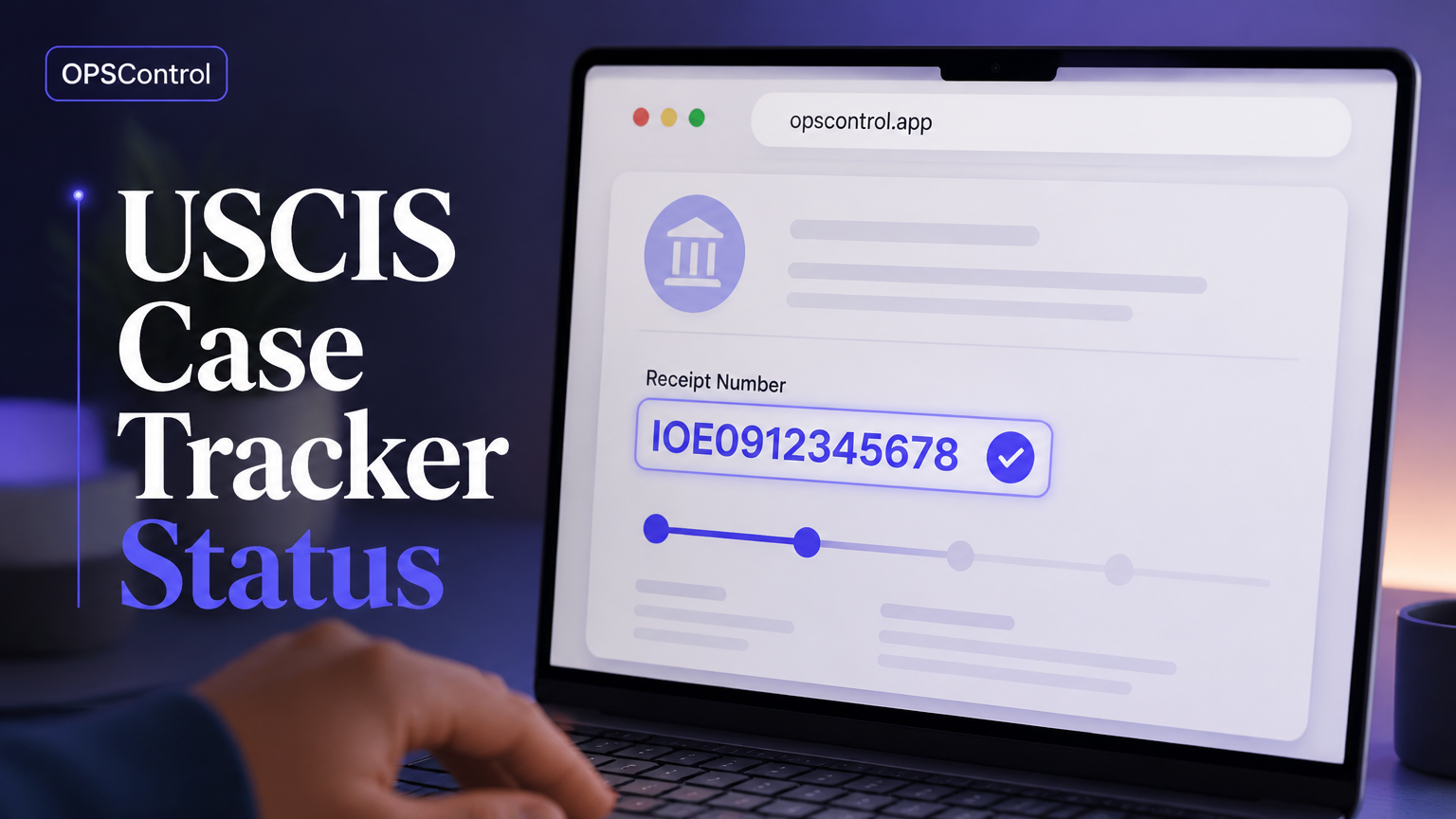
The same control-ops ideas apply to something personal: tracking an immigration case. USCIS publishes changes to case status at unpredictable times, and some updates are silent — no notification is sent. Without a control point, the applicant must remember to check manually and can miss an update for weeks.
OPSControl acts as the control loop. It continuously checks the official status portal (the sensor), compares against the last known state (the comparison), and triggers a notification or timeline record the instant the status changes (the decision and action). You get situational awareness without manual effort.
Frequently Asked Questions
The questions below cover the common confusions about operations controls and their applications.