What to look for in I-485 status alert software
Choosing an I-485 status alert tool is a practical buying decision for anyone who needs to notice a case change without checking the USCIS website repeatedly. The right service should monitor the receipt number over time, record meaningful changes, and tell you what to review next without suggesting that a notification is a final case decision.
A manual check works when you have one quiet case and plenty of time. It becomes less reliable when you are working, traveling, waiting on an EAD, or coordinating several family applications. A useful tracker reduces repetitive checking while leaving the official USCIS record as the source you should consult before taking action.
Start with the basics: continuous monitoring, a clear status history, sensible notifications, transparent pricing, and support for the form you filed. For an I-485, you may also want to track related applications such as the I-765 or I-131 separately, because each receipt number can move on its own timeline.
The official USCIS I-485 page explains the form and its filing context, while a tracker handles a different job: watching for changes after you provide the receipt number. No monitoring product replaces the notices USCIS sends or the case-specific guidance of an immigration attorney.
Essential I-485 case tracker features
✓Continuous receipt-number monitoring: The service should check the case over time rather than relying on a single lookup. Monitoring should end when the case reaches a completed state, so an old case does not remain unnecessarily active.
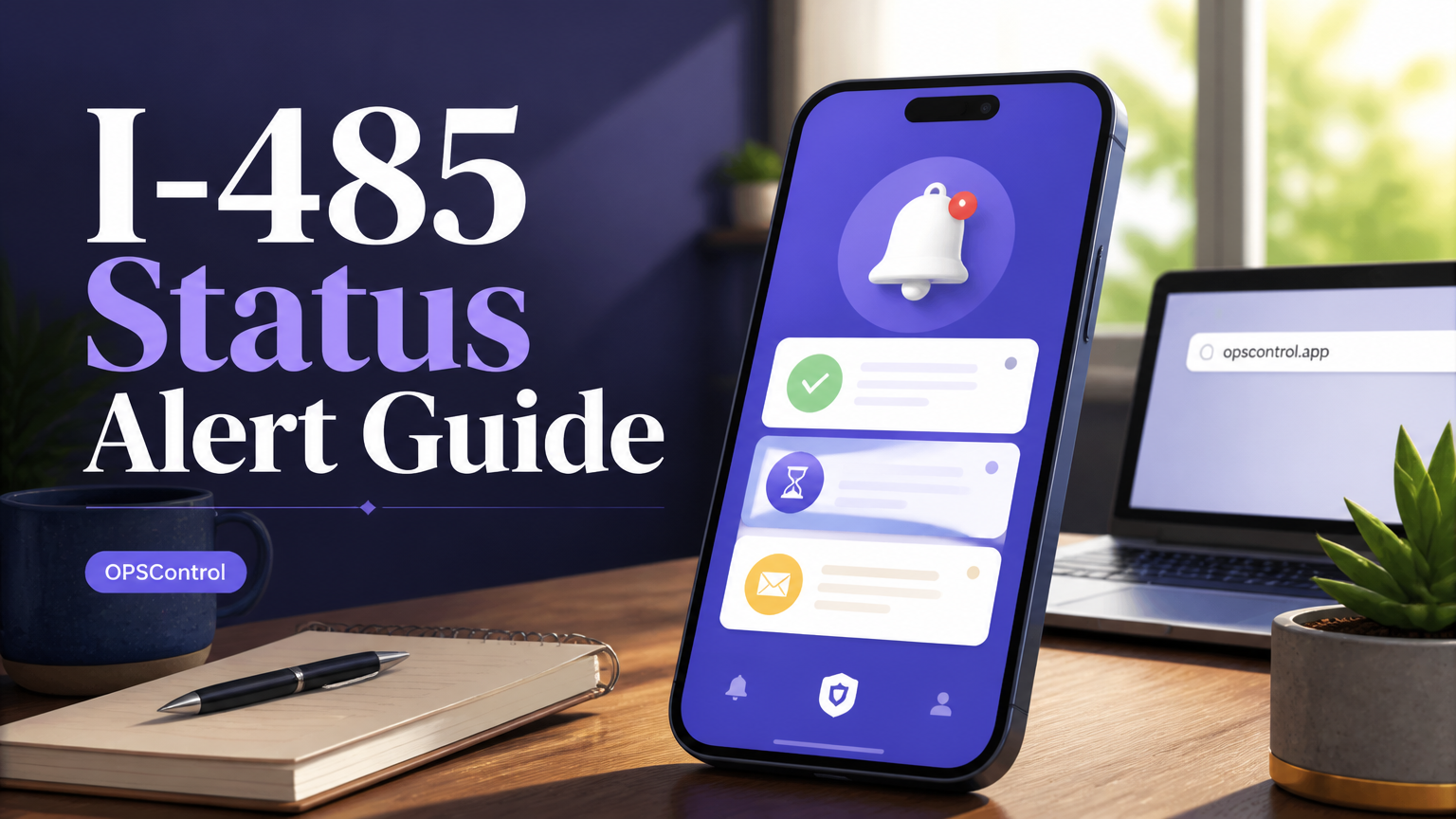
✓Change-focused alerts: A notification should identify that the reported status changed and direct you to review the case details. This is more useful than a generic reminder that your case exists.
✓Silent update detection: Some changes may not be obvious during casual manual checking or may appear between the times you visit the USCIS status page. A tracker that compares observed status data can help surface changes that deserve a closer look, without claiming to capture every possible USCIS event.
✓Complete case timeline: Historical entries help you establish when a status was observed, prepare questions for counsel, and compare related family cases. Keep USCIS notices and account records too, because an external timeline is a convenience record, not the government file.
✓A notification channel you already use: Telegram can be useful when you want a focused alert stream separate from an inbox. Email or SMS may suit users who do not regularly use messaging apps.
✓Transparent payment terms: A one-time charge can be easier to budget for a case that may remain pending for an uncertain period. Check whether the price applies per receipt number, per person, or per household.
✓Multiple-form support: Families often monitor I-485, I-765, I-130, I-751, or N-400 cases at the same time. Confirm that the service supports the specific forms and receipt numbers you need before paying.
✓Privacy and account controls: Review what information is required, how notifications are configured, and whether you can stop monitoring. A receipt number is sensitive case information even though it is not a password.
Manual USCIS checks versus automated I-485 monitoring
The official case status tool remains important because it lets you verify the current information directly. USCIS provides its case status online tool, and applicants should use it when a notification arrives, when a paper notice is received, or when a status appears inconsistent.
Manual checking has no software fee, but it carries a human cost. Someone must remember the receipt number, open the site, complete any required interaction, recognize whether the wording changed, and write down the date if a historical record matters. Checking three family cases once per day means more than 1,000 routine checks in a year, even before checking related forms.
Automated monitoring changes the workflow from 'remember to check' to 'review when there is a change.' It does not change USCIS processing, create a filing advantage, or tell you that an interview or document request will definitely occur. Its value is attention management and a more consistent record.
Consider a household with an I-485, an I-765, and an I-130. A status shift on the I-765 may affect employment planning, while an I-485 update may require careful review of notices or preparation for a future step. Separate alerts make it easier to act on the right receipt number instead of treating every update as one combined case.
For a broader explanation of alert channels and their limits, see this guide to USCIS Telegram alerts.
How to evaluate an I-485 status alert service
Step 1: Map every receipt number — Write down the form type, applicant name, receipt number, filing date, and current status for each case. Do not assume that a spouse's or dependent's case will update at the same time as the principal applicant's case.
Step 2: Confirm the monitoring source — Ask whether the service observes USCIS case status data through an online connection, API, or automated page checks. The important question is how often the service checks and how it distinguishes a new status from an unchanged result.
Step 3: Test the notification workflow — Check whether alerts arrive through Telegram, email, or SMS and whether you can identify the form and applicant in the message. A useful alert should prompt verification, not encourage you to treat a short message as legal advice.
Step 4: Inspect the history before purchasing — Look for a readable timeline that records observed changes and dates. History is especially valuable when you need to explain a sequence to an attorney, compare family cases, or determine whether you already responded to a notice.
Step 5: Calculate the complete cost — Compare one-time pricing with recurring subscriptions over the period you expect to wait, but do not rely on an estimated processing date as a promise. Include every receipt number, since an I-485 household may need separate monitoring for related applications.
Step 6: Create an action rule — Decide in advance what you will do after an alert: open the official USCIS record, check your mail and online account, save the notice, and contact counsel when interpretation is needed. This prevents rushed decisions based only on a notification preview.
Why choose OPSControl for I-485 case monitoring
OPSControl is designed for applicants who want continuous monitoring through the case decision without a recurring subscription. It uses the receipt number to follow supported USCIS cases, sends change notifications through Telegram, keeps a status history, and can identify silent updates that a user may miss between manual checks.
The pricing model is straightforward: US$1.99 as a one-time payment per case, that structure can suit families tracking several applicants, because the cost is attached to each case rather than an indefinite monthly plan.
Setup is intentionally simple. Add the receipt number, select the relevant case information, connect Telegram, and review the first recorded status. Monitoring stops automatically when the case is completed, reducing the chance that a finished application remains in an active monitoring list.
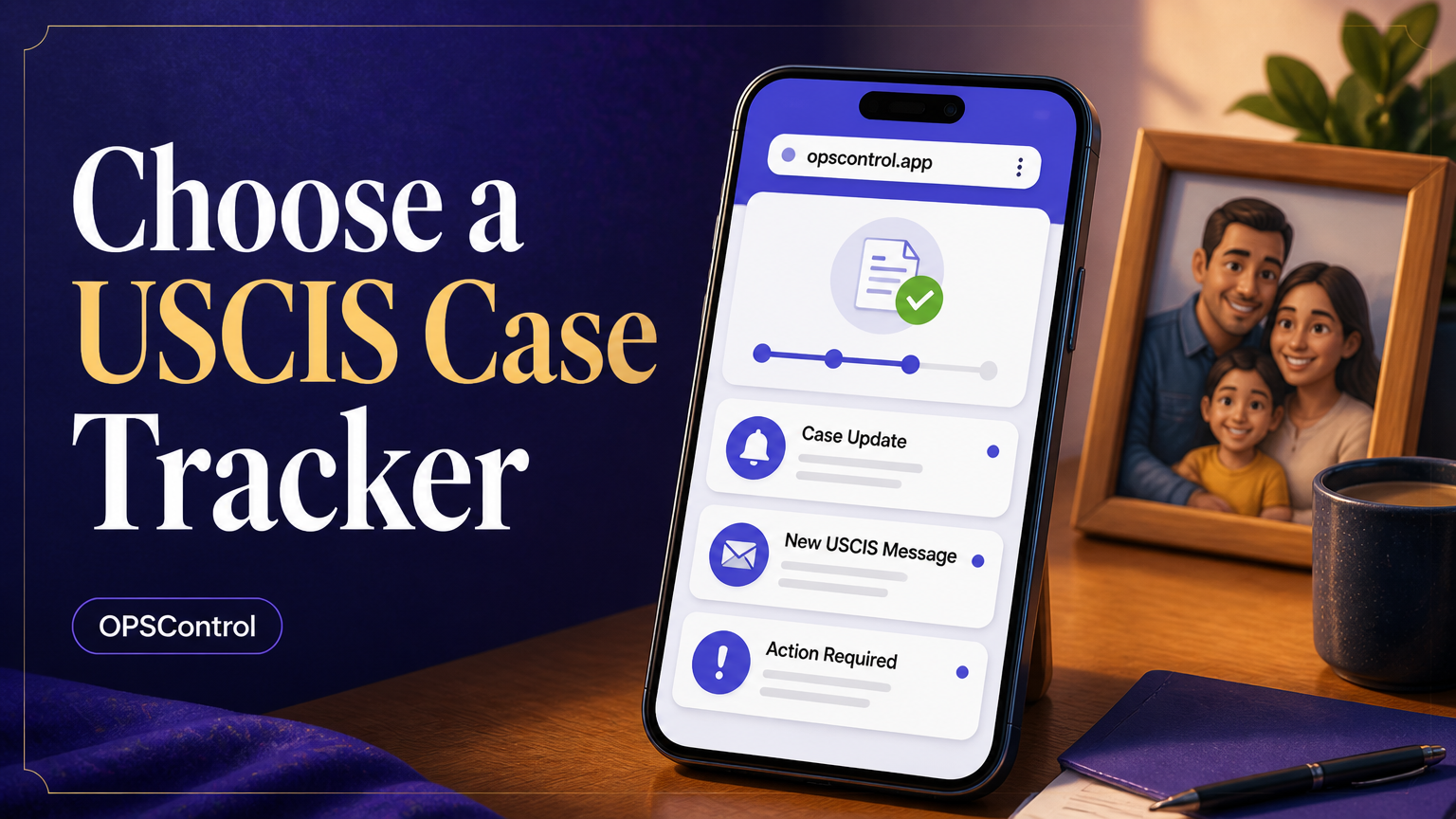
For readers comparing the wider category, the USCIS case tracker evaluation guide offers criteria you can apply to any vendor. OPSControl is a monitoring utility, not a government service or legal adviser, and a status alert cannot tell you how to respond to a request, notice, or interview.
What to do when an I-485 status alert arrives
Treat an alert as a prompt to verify, not as the outcome of your case. Open the official USCIS case status page, compare the wording with the alert, and record the date you reviewed it. If USCIS provides a notice in your account or by mail, save the complete document rather than relying on the short status label.
A status change may affect preparation even when it does not require an immediate filing. For example, an update connected with an interview can make it sensible to organize identity documents, prior notices, and requested evidence. The alert itself does not confirm that an interview will be scheduled, so wait for the actual USCIS notice before making arrangements that depend on a date.
If the wording is unclear, collect the receipt number, full notice, prior timeline, and relevant filing details before contacting an attorney. Avoid submitting an unplanned response simply because an automated message appeared. Legal interpretation depends on facts that a case tracker cannot see.
Processing-time pages can provide context, but they are estimates and are not a forecast for an individual case. USCIS explains how to use its processing times tool and what information it displays. Use that information to frame questions, not to set a guaranteed deadline.
For related employment-document monitoring, the EAD renewal alerts guide covers a separate but often connected workflow. Keeping the I-765 and I-485 timelines distinct helps prevent an update on one application from being mistaken for an update on another.
Common buying mistakes to avoid
✓Buying by notification speed alone: A message is useful only if the underlying case data is identified clearly and you can verify it. Ask about monitoring frequency and recognize that delivery can depend on the notification platform and connectivity.
✓Using one receipt number for the whole family: Each application has its own receipt number and may have a different status. Build a labeled list before activating monitoring.
✓Treating the status label as legal guidance: A tracker reports observed information. It cannot determine whether you should file something, respond to a notice, or change an immigration strategy.
✓Ignoring the official notice: A short alert is not a substitute for the full notice delivered by USCIS. Check your mail and online account, then preserve the document with your records.
✓Paying for a subscription without calculating the waiting period: Compare the total expected cost, cancellation rules, and per-case terms. A one-time model may be more predictable when no end date is known.
✓Expecting monitoring to accelerate a case: Tracking improves awareness and organization, but it does not alter USCIS queues, decisions, or processing times.
✓Failing to secure the account: Use a strong password, limit access to the Telegram conversation, and avoid posting receipt numbers in public groups. Remove monitoring when it is no longer needed.
A simple decision framework for your I-485 tracker
Choose manual checks when you have one case, check infrequently by choice, and are comfortable keeping your own dated notes. This approach costs nothing, but it depends entirely on your routine and does not provide a proactive notification when a change is observed.
Choose automated monitoring when repeated checking is affecting your concentration, when your work schedule makes daily visits difficult, or when several family receipt numbers need consistent attention. The strongest fit is a service with clear per-case pricing, a persistent history, and a notification channel you will actually open.
Before checkout, verify four details: the exact receipt number, the form type, the notification destination, and the price for all cases. Then create a response checklist that includes official verification, document preservation, and professional advice when the situation requires legal interpretation.
Readers who also need to organize petition-related cases can review how to track an I-140 case status and how to check an I-130 status online. Those workflows reinforce the same principle: track each receipt number separately and keep the government record as the final reference.
For many applicants, the value of a one-time monitoring purchase is not a prediction. It is the ability to stop spending attention on repetitive checks while retaining a useful timeline until the case reaches its reported conclusion.